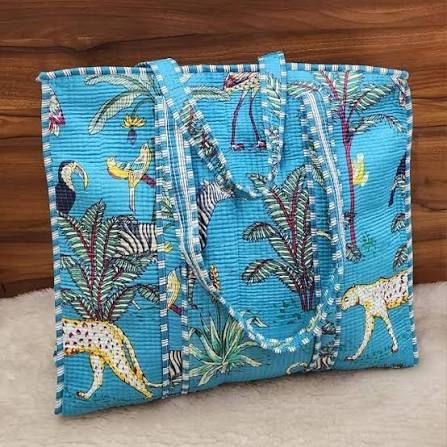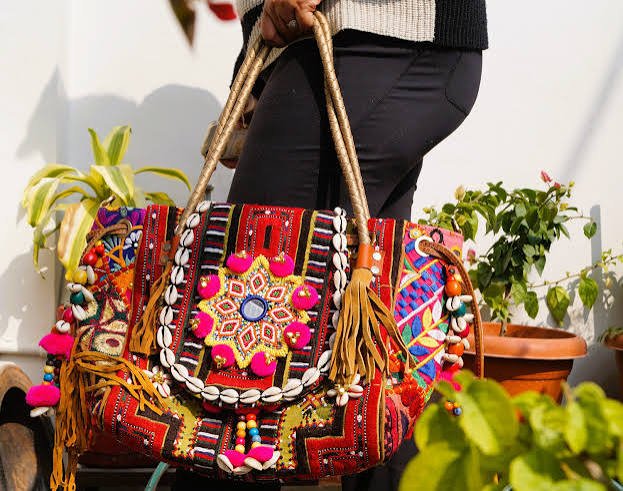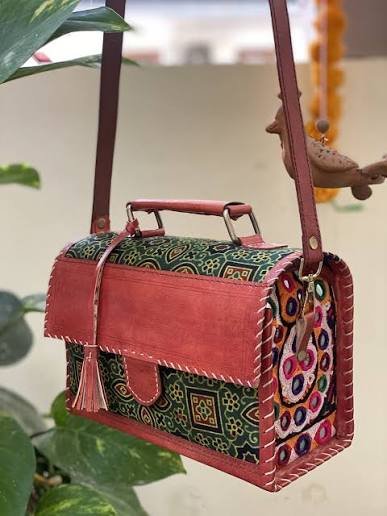

Buying a handmade bag should feel exciting—not like solving a mystery.
However, many products are described as “artisan-made”, “handcrafted” or “hand-finished” without clearly explaining how they were produced. Some may involve genuine handwork, while others may simply use a digital print or decorative element inspired by a traditional Indian craft.
So, how do you separate genuine craftsmanship from clever marketing?
This guide explains how to identify a handmade bag by examining its stitching, material, printing, embroidery, lining, hardware and product information.
Quick Answer: How to Identify a Handmade Bag
An authentic handmade bag usually shows slight variations in stitching, print alignment, embroidery or colour. It should also provide information about its material, technique, maker or craft region. Perfectly identical patterns, unfinished synthetic edges and vague “artisan-inspired” descriptions may indicate mass production instead of genuine handcraft.
Handmade Bag Authenticity Checklist
A genuine handcrafted bag should usually have:
- Small, natural variations rather than obvious defects
- Secure stitching and reinforced stress points
- Neatly finished seams, edges and thread ends
- Believable variation in embroidery, weaving, painting or printing
- Specific material and production information
- Strong handles, closures, lining and hardware
- Details about the maker, workshop or craft region
- Clear photographs, care instructions and return terms
Learning how to identify a handmade bag does not mean searching for crooked stitches. Skilled handwork can be extremely neat.
You are looking for evidence of human involvement, sound construction and honest product information.
What Does “Handmade” Actually Mean?
In ordinary usage, handmade means that a person has created a product mainly through hand skill rather than through a completely automated production line. Handicraft also generally refers to skilled work completed traditionally by hand rather than through factory-based mass production. (Cambridge Dictionary)ch17turn869054search26
This does not mean that an artisan must avoid every tool.
A craftsperson may use:
- A sewing machine
- A handloom
- Wooden printing blocks
- An embroidery frame
- An awl
- Cutting tools
- Small presses
- Polishing and finishing equipment
The important question is whether human skill controls the major stages of production.
For a handmade bag, these stages may include selecting the material, cutting the panels, weaving or decorating the surface, attaching the lining, finishing the edges and fitting handles or closures.
India’s official handicrafts ecosystem recognises individual artisans, specialised skills and geographical craft clusters. The Indian Handicrafts Portal also maintains an artisan database and supports artisan identity registration.
A bag does not need to carry a government artisan card to be authentic. Nevertheless, credible information about the maker, workshop or craft cluster can strengthen a seller’s handmade claim. (Indian Handicrafts)ade vs Handcrafted vs Hand-Finished Bags
These descriptions are frequently used as though they mean the same thing. In practice, they may represent different levels of manual involvement.
| Label | What it usually suggests |
|---|---|
| Handmade | Important stages of production are completed or directly controlled by a maker. |
| Handcrafted | Similar to handmade, but often places greater emphasis on skill, technique and artistic design. |
| Hand-finished | A mainly machine-made product receives limited manual work such as embroidery, painting, polishing or embellishment. |
| Artisan-inspired | The design resembles a traditional craft, but the product may be digitally printed or factory-produced. |
| Handmade-style | A visual description rather than proof that the product was made by hand. |
A hand-finished bag is not necessarily poor quality.
For example, a factory-stitched canvas tote decorated with genuine hand embroidery can be attractive and durable. The issue is whether the seller honestly explains which parts were handmade.
That distinction is important when understanding how to identify a handmade bag online.
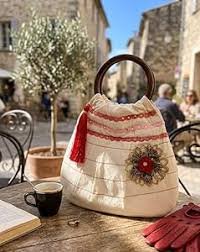
12 Signs of an Authentic Handcrafted Bag
1. Natural Variations Appear in the Right Places
Controlled variation is one of the clearest signs of a handcrafted bag.
A hand-block-printed bag may show tiny shifts in motif placement. Hand embroidery may contain small differences in stitch length. Handwoven fabric may have subtle changes in texture, yarn thickness or tension.
These variations should look natural rather than careless.
A slightly uneven flower may show the hand of the maker. A twisted handle, open seam or badly misaligned flap shows poor quality control.
When learning how to identify a handmade bag, remember this simple rule:
Variation may indicate handwork, but damage is still damage.
Do not allow a seller to describe every quality problem as “the beauty of handmade production”.
2. Stitching Is Secure and Reasonably Consistent
Examine the long seams, corners, pockets and bottom of the bag.
Handmade stitching should feel firm and appear controlled. Minor differences may occur when a bag is sewn by hand, but loose loops, missed stitches, open seams and dangling threads are warning signs.
Check for:
- Straight or deliberately curved seam lines
- No gaps between joined panels
- Properly secured thread ends
- No unnecessary puckering
- Adequate seam allowance
- Neatly finished interior stitching
Uneven stitching by itself does not prove that a bag is handmade. It may simply indicate poor workmanship.
A proper bag quality check should distinguish between small human variations and construction that is likely to fail.
3. Handles and Stress Points Are Reinforced
Handles, shoulder-strap joints, zip ends, pocket openings and base corners carry the greatest amount of pressure.
A well-made bag will normally reinforce these areas using:
- Additional rows of stitching
- Box-shaped stitches
- Cross stitches
- Bar tacks
- Rivets
- Folded fabric
- Leather patches
- Internal backing layers
Gently pull the handles and inspect their attachment from both the outside and inside.
The area should feel stable. It should not stretch, crackle, loosen or appear dependent only on glue.
This is one of the most practical lessons in how to check bag quality. A bag may have beautiful embroidery or block printing but fail within weeks when its handles are attached to a single thin layer of fabric.
4. Prints Do Not Repeat with Digital Perfection
Hand-block printing, hand painting and resist dyeing usually create small differences in colour pressure, spacing, outline and saturation.
Digital printing, by comparison, reproduces the same details precisely.
Zoom in on repeated flowers, leaves or geometric motifs. Check whether every faded edge, tiny dot and supposed imperfection appears in exactly the same position.
When the irregularities repeat perfectly, they may be part of a digital design created to imitate hand printing.
This test is especially useful when deciding how to identify a handmade bag online, where you cannot feel or closely inspect the material.
Digital printing is not automatically bad. It simply should not be advertised as hand-block printing or hand painting.
5. Embroidery Has Real Thread Structure
Printed designs can imitate kantha stitches, mirror work, beadwork and traditional thread embroidery from a distance.
Close-up photographs should reveal whether threads physically pass through the fabric.
Look for:
- Raised thread texture
- Small thread entry and exit points
- Natural changes in stitch direction
- Securely attached mirrors, beads or sequins
- Proper backing where needed
- Neatly finished thread ends
The reverse side can be particularly useful. It should reveal genuine thread work, although it does not need to look as decorative as the front.
Long, loose thread floats and oversized knots may catch on other objects. Genuine hand embroidery should still be finished carefully enough for regular use.
6. The Material Description Is Specific
Material is central to how to identify a handmade bag.
Cotton, canvas, jute, wool, leather, bamboo, cane and handwoven textiles all have different textures and performance characteristics.
For textile bags, check whether the weave appears dense enough for the intended purpose. A laptop bag, for example, requires stronger fabric and reinforcement than a lightweight potli bag.
For jute bags, check whether the weave is stable and whether loose fibres are excessive.
For leather bags, natural grain may vary across panels. A perfectly repeating grain pattern may indicate an embossed or corrected surface. However, natural material variation alone does not prove that a bag was handmade.
Be cautious when listings use vague descriptions such as:
- Premium fabric
- Leather finish
- Natural-style fibre
- Vegan material
- Imported cloth
- Artisan textile
The seller should clearly state what the bag is made from.
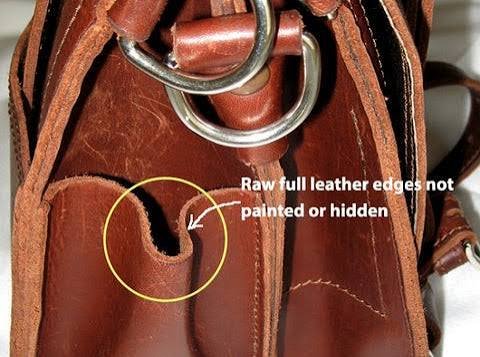
7. Raw Edges Are Properly Finished
Edges reveal how much time and attention went into a bag.
Textile edges should normally be:
- Folded
- Bound
- Piped
- Overlocked
- Enclosed inside the lining
Leather edges may be folded, burnished, painted or covered with binding.
The ends of cane, bamboo, jute or woven fibres should be tucked, wrapped or sealed so that they do not scratch the user or gradually unravel.
When examining the signs of a handcrafted bag, inspect hidden areas as well:
- Under the flap
- Around the zip
- Inside pockets
- Behind the handles
- Along the base
- At the bottom corners
A polished front cannot compensate for exposed adhesive, shedding fibres or unfinished seam allowances inside the bag.
8. Hardware and Closures Work Smoothly
Examine the zips, sliders, buckles, magnetic buttons, hooks, rings, rivets and clasps.
These components do not have to be expensive or decorative. They should simply be suitable for the size and intended use of the bag.
Better bag construction normally includes:
- A zip that opens without catching
- Zip tape stitched without waves
- No sharp metal edges
- Rings that close completely
- Rivets that do not rotate loosely
- Reinforcement behind magnetic buttons
- Buckles aligned with the strap
- Consistent hardware finishes
An authentic handmade bag can contain commercially manufactured zips and metal fittings.
The artisan does not need to manufacture every zip tooth by hand. Authenticity comes from how carefully the components are selected, attached and finished.
9. The Lining Supports the Bag
Many buyers examine the outer embroidery or printing but forget to look inside.
A good lining should fit the bag without excessive bunching. It should support the pockets and either conceal or neatly finish the internal seams.
Look for:
- Secure pocket stitching
- No large loose folds
- No open seams
- No visible glue stains
- Fabric that does not transfer colour easily
- Sufficient strength for everyday belongings
The lining should be able to handle keys, chargers, cosmetics and other objects without tearing.
Some leather, crochet, macramé and tightly woven bags are intentionally unlined. That is acceptable when the inner surface is clean, stable and suitable for regular use.
Checking the interior is an essential part of learning how to identify a handmade bag that will also last.
10. The Seller Identifies the Technique or Craft Region
A trustworthy product listing normally says more than “beautiful artisan bag”.
It may name the:
- Craft technique
- Artisan
- Workshop
- Producer collective
- Village
- Town
- State
- Geographical craft cluster
Indian handicraft clusters are linked to identifiable geographical areas and specialised products. India’s Geographical Indications registry also includes protected regional crafts and textiles, including recognised names such as Pochampally Ikat and Chanderi. (Indian Handicrafts)e can support the geographical origin of a registered product. However, a GI registration is not a universal handmade certificate for every bag.
Helpful product descriptions may say:
- Hand-block printed in Jaipur
- Kutchi embroidery completed by a women’s artisan collective
- Handwoven fabric sourced from a named weaving cluster
- Bag assembled in a small Kolkata workshop
- Made by a named artisan or producer group
Specific and verifiable information makes it easier to understand how to identify a handmade bag before paying for it.
11. Photographs Show Construction Details
A handmade seller should ideally provide enough photographs for buyers to examine the product.
Look for:
- Front and back views
- Side and base views
- Photographs of the interior
- Close-ups of stitching
- Close-ups of embroidery or surface decoration
- Handle and strap attachments
- Zips, buttons and other closures
- An image showing the bag’s size when carried
When natural variation is expected, the listing should explain that the delivered piece may differ slightly from the photograph.
A reverse-image search can also be useful. When the exact same product photograph appears across several unrelated websites with different brand stories, ask the seller whether the image shows the actual bag.
You can also ask where it was made and which stage involved handwork.
12. The Price and Availability Make Sense
A high price does not prove that a bag is handmade. Similarly, a low price does not automatically mean that it is fake.
Nevertheless, the price should reasonably reflect:
- Material cost
- Artisan labour
- Production time
- Complexity of the technique
- Quality of finishing
- Transport and packaging
- Seller margins
Be cautious when an intricate handmade bag is available in hundreds of perfectly identical units, permanently discounted by 80% and sold without any production details.
Other warning signs include many unrelated sellers using the same photographs and a finished price that appears lower than the likely cost of the raw materials.
Artisans can make batches and repeat popular designs. Quantity by itself is not proof of factory production.
It is the combination of unlimited stock, exact uniformity, unusually low pricing and vague sourcing that should raise concern.
Handmade vs Machine-Made Bags: Quick Comparison
| What to check | Handmade or genuinely handcrafted | Mainly machine-made |
|---|---|---|
| Stitching | Secure, with minor human variation possible | Highly uniform and standardised |
| Prints | Small shifts in pressure, spacing or saturation | Identical repeated details |
| Embroidery | Physical thread and natural variation | Printed or automated and extremely regular |
| Edges | Individually folded, bound, burnished or finished | Standardised finishing |
| Material | Specific details and natural character | Frequently more uniform or composite |
| Product description | Maker, process or region explained | Generic “artisan-style” language |
| Availability | Small batches and variation are common | Large identical inventory is common |
| Quality | Depends on artisan skill and checking | Depends on factory standards and checking |
The handmade vs machine-made bags comparison is not simply a question of good versus bad.
A factory can produce an excellent and durable bag. A poorly made handmade bag can fail very quickly.
Knowing how to identify a handmade bag helps you confirm that the product matches its description and your expectations.
Red Flags in Online Handmade Bag Listings
Online shopping requires additional caution because you cannot physically inspect the product.
Be careful when:
- “Handmade” appears in the title but the process is never explained.
- “Artisan-inspired” is presented as though it means artisan-made.
- The exact material is not mentioned.
- Measurements, lining details or closure information are missing.
- Only digital renders or heavily edited photographs are shown.
- The seller refuses to explain where or by whom the bag was made.
- Identical photographs appear under several unrelated brand names.
- Customer reviews appear copied or repetitive.
- Review photographs show a different product.
- Return terms exclude every type of quality complaint.
Indian consumers have a recognised right to information and a right to seek redressal against unfair trade practices. The Government of India’s National Consumer Helpline provides a grievance channel when a genuine issue remains unresolved by the seller. (Consumer Affairs)ons to Ask Before Purchasing a Handmade Bag
You do not need to interrogate a small seller. A few polite and specific questions can provide useful information.
Ask:
- Which parts of the bag are made by hand?
- Is the fabric handwoven, hand-printed or commercially produced?
- Who makes the bag—an individual artisan, collective or workshop?
- Where is the bag made?
- Will my piece vary from the displayed photograph?
- What are the exact outer and lining materials?
- Are the handles reinforced for regular use?
- How much weight can the bag safely carry?
- What care does the bag require?
- Can it be repaired if a zip, handle or seam fails?
- What is the return policy for a quality problem?
A genuine seller may not hold formal certificates. However, the seller should normally be able to answer practical questions about the material and production process.
Printable Handmade Bag Buying Checklist
Use this checklist whenever you are unsure how to identify a handmade bag:
- The seller explains what was completed by hand.
- The exact material is clearly named.
- Close-up photographs show seams and surface work.
- Stitching and thread ends are secure.
- Handles and straps are reinforced.
- Prints, weaving or embroidery show believable variation.
- Edges are folded, bound, sealed or burnished.
- Hardware works smoothly.
- The lining and pockets are neatly attached.
- The maker, workshop or craft region is identified where possible.
- Measurements and care instructions are provided.
- The price and availability appear believable.
- Return or replacement terms are clear.
Final Verdict: Buy the Workmanship, Not Just the Story
The best method for how to identify a handmade bag is to combine three kinds of evidence:
- Visible craftsmanship
- Strong construction
- Transparent seller information
Check the stitches, handles, prints, embroidery, edges, lining and closures. Then see whether the seller clearly identifies the material, technique and maker.
A romantic artisan story cannot rescue a weak seam. At the same time, perfectly neat machine stitching does not disprove hand embroidery, hand painting or other manual work elsewhere on the bag.
An authentic handmade bag should reward both your eye for beauty and your practical judgement.
Frequently Asked Questions
How can I tell whether a bag is genuinely handmade?
Look for controlled variations in stitching, printing, weaving, embroidery or colour, together with neat construction and clear information about the production process. Learning how to identify a handmade bag requires checking both the physical workmanship and the transparency of the seller.
Does uneven stitching prove that a bag is handmade?
No. Minor differences may occur in hand sewing, but loose, widely irregular or incomplete stitches indicate poor workmanship. Uneven stitching alone is not reliable proof of handmade production.
Is a sewing-machine bag still handmade?
It can be. Many artisans use sewing machines as tools while personally cutting, assembling, decorating and finishing their bags. Handmade does not necessarily mean that every individual stitch was completed without a machine.
Are all handmade bags completely unique?
Not always. Artisans can follow templates and repeat successful designs. They may also produce coordinated batches. However, hand printing, embroidery, weaving, dyeing and painting generally create small differences between individual pieces.
Is a GI tag proof that a bag is handmade?
No. A Geographical Indication protects the identity of a product associated with a particular geographical origin and recognised characteristics or reputation.
It is not a general certificate proving that every stage of a bag was completed by hand. Buyers should check the specific GI registration, sourcing information and product description. (Intellectual Property India)o I check bag quality while shopping online?
Zoom into the seams, handle attachments, embroidery, edges, zips and lining. Read the complete material and production description, compare customer photographs, review the return terms and request additional close-ups when important details are missing.
Are handmade bags always better than machine-made bags?
No. Handmade and machine-made describe production methods, not guaranteed levels of quality.
A well-made factory bag may be stronger than a poorly constructed handmade bag. Genuine craftsmanship is valuable when it combines skilled work, durability, traceability and honest representation.
Why are authentic handmade bags often more expensive?
The price may include skilled labour, slower production, small batches, specialised techniques, careful finishing and fairer payments to makers.
Compare the price with the bag’s material, complexity, durability and sourcing rather than trusting the word “handmade” alone.
See Also
How to Spot Fake Designer Bags (Ultimate Guide)
Epic handbag search!! How to identify bags that match your lifestyle
Best FashionBag for You: Your Ultimate Guide to Finding the Best Handbags Online in India
Bags for Oversized T-Shirt Outfits: Indian Streetwear Accessory Guide